
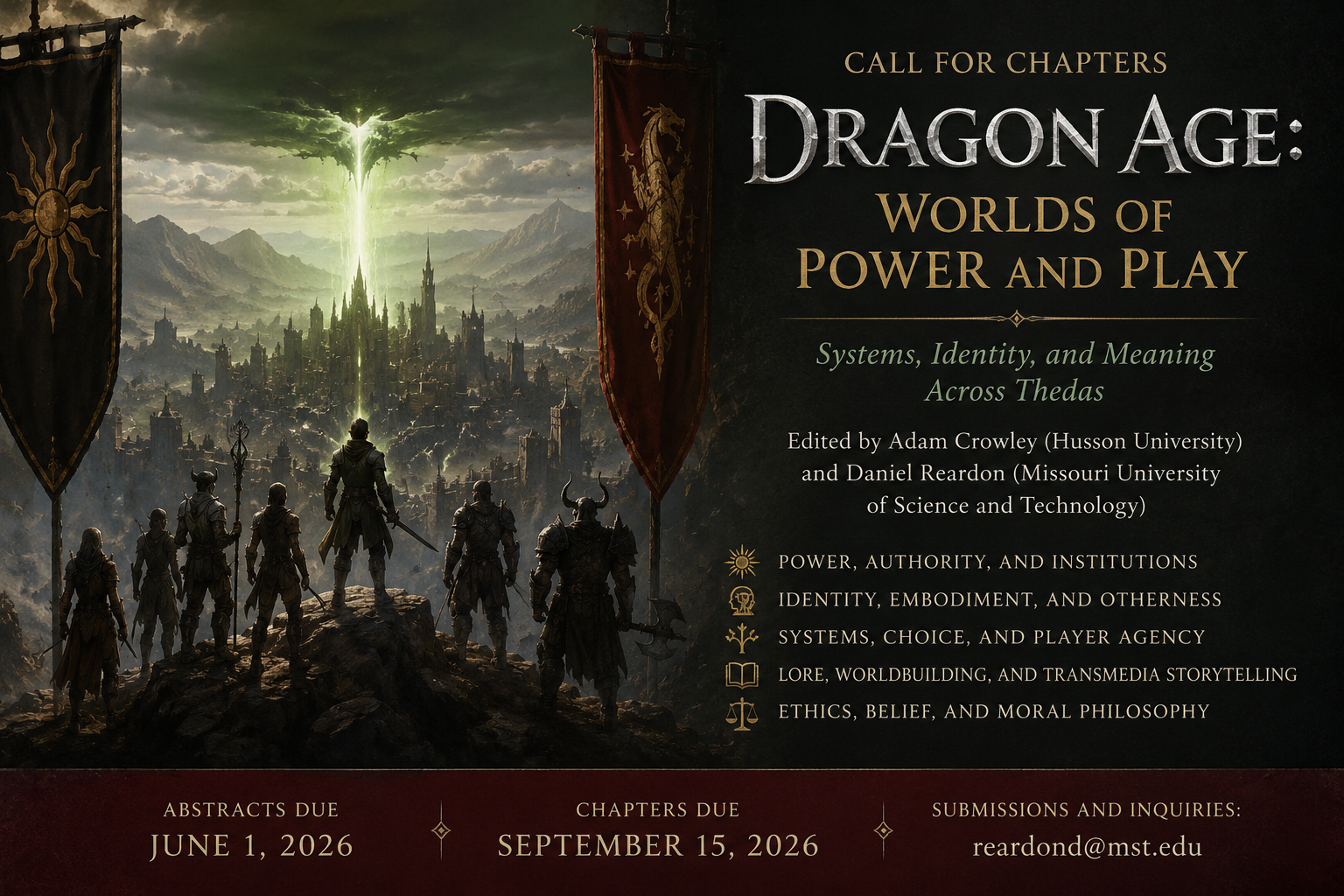
Dragon Age: Worlds of Power and Play
Systems, Identity, and Meaning Across Thedas
Edited by Adam Crowley (Husson University) and Daniel Reardon (Missouri University of Science and Technology)
The Dragon Age franchise (BioWare, 2009–present) stands as one of the most narratively and philosophically ambitious bodies of work in contemporary role-playing games. Across its major titles, the series constructs a world shaped by conflict, belief, and consequence—where institutions govern bodies, identities are contested, and player choice operates within systems that both enable and constrain action.
This edited collection invites scholars to examine Dragon Age as a site of meaning-making across narrative, mechanical, cultural, and philosophical dimensions. We seek contributions that engage the series not simply as a set of texts, but as a structured system in which power, identity, agency, and belief are produced, negotiated, and experienced.
This collection takes a comprehensive view of the franchise, including Dragon Age: Origins, Dragon Age II, Dragon Age: Inquisition, and Dragon Age: The Veilguard. At the same time, Dragon Age operates as a transmedia world rather than a closed set of game texts. We therefore welcome contributions that engage the broader narrative and paratextual ecosystem of the series, including novels, comics, strategy guides, codices, and reference works such as The World of Thedas volumes, as well as screen-based media such as Dragon Age: Redemption and animated adaptations. Essays may focus on a single game, trace developments across multiple titles, or examine how meaning emerges through the interaction of game systems and transmedia storytelling. We are particularly interested in work that attends to the relationship between narrative, system design, and player experience across these materials.
Areas of Interest
1. Power, Authority, and Institutions
Essays in this category may examine the structures that organize and regulate life in Thedas, including the Chantry, the Circles of Magi, the Templar Order, and the Inquisition. Approaches may include political theory, rhetorical analysis of governance, institutional critique, and studies of legitimacy, surveillance, and control.
2. Identity, Embodiment, and Otherness
This section invites work on race, gender, sexuality, and the body within Dragon Age. Topics may include the construction of elven, Qunari, dwarven, and human identities; representations of difference and marginalization; romance and intimacy systems; and the relationship between player identity and character embodiment.
3. Systems, Choice, and Player Agency
Contributions may explore how Dragon Age structures player action through dialogue systems, branching narratives, and moral decision-making frameworks. We welcome analyses of agency, constraint, consequence, and the role of the player as a co-creator within designed systems.
4. Lore, Worldbuilding, and Transmedia Storytelling
This category focuses on the narrative architecture of Dragon Age across games, codices, novels, comics, and other media. Topics may include paratexts, environmental storytelling, worldbuilding practices, and the role of distributed narrative in shaping player understanding.
5. Ethics, Belief, and Moral Philosophy
Essays may address the ethical and philosophical questions at the heart of Dragon Age, including justice, faith, sacrifice, and moral responsibility. We invite work that engages the series’ treatment of belief systems, divine authority, and the player’s role in navigating complex moral landscapes.
Please submit proposals by June 1, 2026. Drafted chapters will be due September 15, 2026.
Submission Guidelines
● Abstracts: Maximum 750 words
● Include: Title, abstract, and brief bio (100–150 words)
● Format: Word document (.docx)
● Email submissions to: reardond@mst.edu

Become a DiGRA Member
Join the premier international association for professionals, academics, developers and other individuals interested in the evolving fields of digital gaming and game studies.