

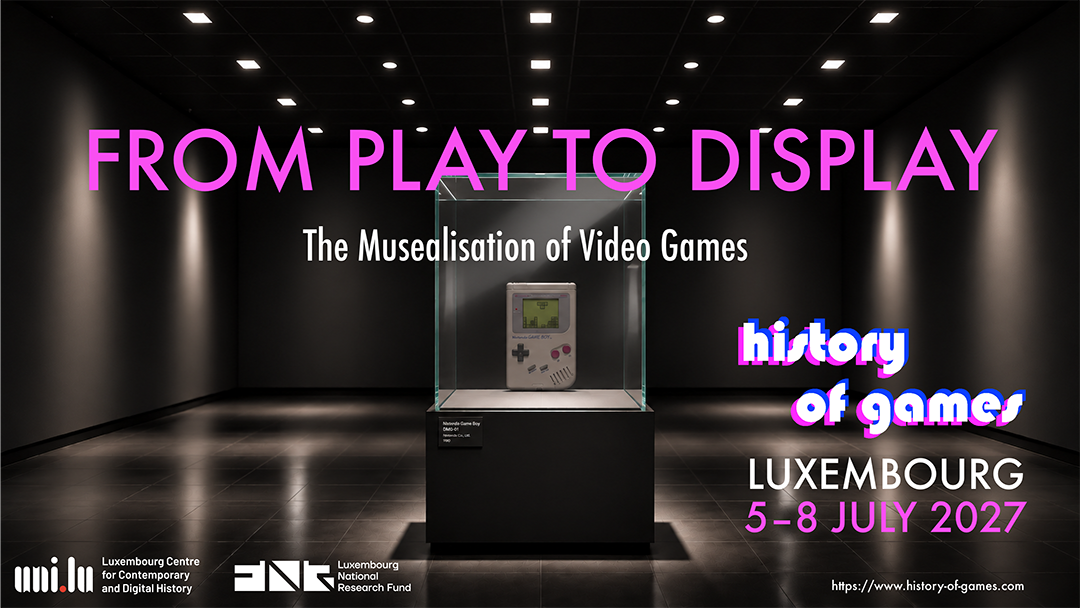
By the late 20th century, video games had grown from ephemeral entertainment to enduring cultural artefacts. Long subject to cultural hierarchies that framed games and play as trivial, they are now collected, catalogued, exhibited, and celebrated. While video games have entered the realm of musealisation, how their histories are constructed, what is remembered, what is forgotten, and the ways in which they are preserved and exhibited, remains the subject of ongoing debate.
Dominant narratives of video game history have often privileged certain regions, genres, devices and platforms: Japan and the United States as main producers, role-playing and first-person shooters as emblematic formats, and home consoles as the quintessential hardware. Yet counter-histories thrive elsewhere. European microcomputer cultures, South American and Eastern European bootleg markets, African arcades, and grassroots modding communities reveal alternative genealogies. Regional specificities, often overlooked in favour of a global mainstream, demand new forms of recognition within the museum and the archive.
Meanwhile, preservation remains one of the fundamental challenges associated with the musealisation of video games. From fragile physical cartridges to volatile digital files, from custom controllers to network-dependent MMOs, games resist traditional archival practices. Metadata standards struggle to capture their hybrid nature as both software and cultural experience. “Rogue archives” (De Kosnik, 2016), fan-made databases, emulation projects, and pirate networks have stepped in where institutions faltered, raising questions about legality, legitimacy, and cultural stewardship.
Museums and galleries, for their part, have increasingly confronted the issue of how to exhibit games: as playable experiences, as art installations, as historical artefacts, or as media texts. Online collections compete with physical exhibitions, while hybrid approaches experiment with accessibility, preservation, and interactivity. Amateur collectors and grassroots initiatives intersect, and sometimes clash, with institutional frameworks. Curatorial strategies oscillate between nostalgia, scholarship, and spectacle.
For History of Games 2027, we invite you to interrogate the musealisation of the video game. How do we preserve, archive, and exhibit games in ways that address their complexity as technical objects, cultural practices, and works of art? What tensions exist between amateur and institutional approaches, between canonical histories and marginalised counter-histories, between physical display and digital accessibility?
The primary focus of History of Games 2027 is on digital games. We nevertheless welcome selected contributions on analogue and tabletop games where they address issues of preservation, collection, exhibition, documentation, historical interpretation, or museum practice, particularly where they offer comparative perspectives or illuminate broader questions of game heritage.
Possible topics include, but are not limited to:
– Canon formation and its disruptions in video game history
– Regional and national trajectories of preservation and exhibition
– Rogue archives, piracy, and emulation as heritage practices
– Metadata, standards, paratexts, and the documentation of video games and gaming cultures.
– Amateur collecting and grassroots preservation movements
– Institutional archives and their strategies for acquisition and display
– Online vs. physical exhibitions of video games and gaming culture
– Games as art objects, installations, and curatorial experiments
– Playability, authenticity, and the reconstruction of historical gameplay experiences
– The materiality of video games: hardware, interfaces, peripherals.
– Case studies of exhibitions, collections, or preservation projects
– The politics of representation and inclusion in video game musealisation
– Legal and ethical challenges of collecting, preserving, and exhibiting video games
Important dates
Submission system opens: 9 November 2026
Abstract submission deadline: 31 January 2027
Doctoral Consortium submission deadline: 31 January 2027
Notification of acceptance: 31 March 2027
Early-bird registration: 15 April 2027
Final programme: 15 May 2027
Conference dates: 5-8 July 2027